CLP Labels for Candles: A Practical Guide for UK Makers
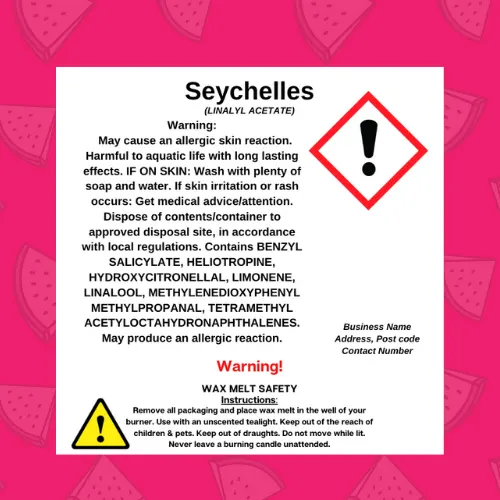
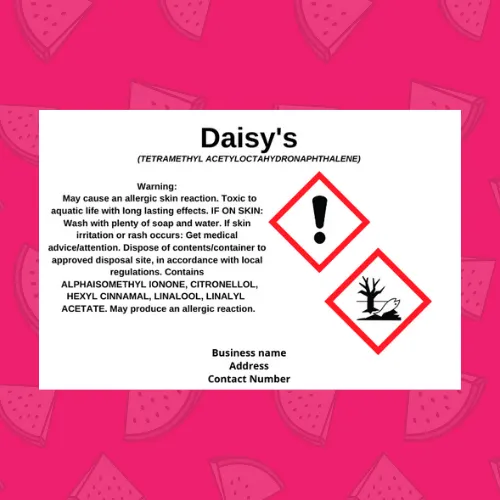
CLP labels for candles are the warning labels that UK and EU rules require when a scented candle contains ingredients classed as hazardous. Not every candle needs one. If your fragrance oil carries a hazard classification at the concentration you use, the finished candle usually does, and the label has to be on the container or packaging before it is sold.
What a CLP label for a candle must contain
The rules come from the CLP Regulation (Classification, Labelling and Packaging). A compliant label has a fixed set of elements, and leaving one out is the most common reason labels get rejected by trading standards.
- A product identifier, such as the candle name or scent name
- The relevant hazard pictogram, printed in a red diamond border
- A signal word, either "Warning" or "Danger"
- Hazard statements, for example H317 "May cause an allergic skin reaction"
- Precautionary statements, for example P102 "Keep out of reach of children"
- Supplier name, address and phone number
- Names of the allergenic or hazardous ingredients that triggered the classification
- Nominal quantity, usually the weight in grams
The supplier details are the part people forget. A social media handle does not count.
Sizes, fonts and pictograms
Pictograms must be at least 10 mm by 10 mm on small packs, and the smallest container size usually sets the limit. For containers up to 3 litres, which covers every candle, the pictogram is normally at least 16 mm by 16 mm when the label is large enough to carry it. Text should be at least 1.2 mm in x-height, which in practice means around 6 to 7 pt in a clear sans serif font.
Black text on white is the safest choice. Keep the red border of the pictogram clean and sharp, because a blurry diamond is easy to spot as a problem.
Small jars and tins
A 30 ml tin or a 90 ml jar leaves very little room. Many makers print a wraparound label or a fold-out label that holds the full warning text while the front stays tidy. Another option is a combined warning label on the base, with the brand label on the front.
Where the label goes
It must be visible, legible and firmly attached. A label on the bottom of a jar is acceptable if the candle is not sold in outer packaging that hides it, but most makers put it on the side or back. If the candle is boxed, the label should be on the box as well, or the box must be clear.
Use a waterproof or wax-resistant material. Paper labels on warm glass lift and curl within weeks, and vinyl or a laminated finish holds up much better. If you plan to order matching business stickers for lids and seals, ask for the same material so the finish looks consistent.
How to know if your candle needs a CLP label
Start with the safety data sheet from your fragrance supplier. It lists the classification and the percentage limits. Then check your fragrance load: a candle at 6% fragrance oil can cross a threshold that a 3% candle does not. Some makers lower the load to stay unclassified, though most prefer to keep scent strength and simply label.
Essential oils are not exempt. Many, such as citrus and lavender oils, carry sensitisation warnings of their own.
Candles versus wax melts
The legal requirements are the same, but the layout differs because melts are sold in clamshells, bags or pots. Guidance on clp labels for wax melts covers square and round formats, and many makers also need the extra instruction text that goes with clp wax melts, such as "Do not leave unattended" and "Never use with a naked flame in the base."
Common mistakes with 10 candles and small batches
Makers searching for "10 candles" are often testing a first small batch. Small does not mean exempt. A run of 10 candles sold at a market is still a product placed on the market, so the label rules apply from the first sale.
- Copying a competitor's label, which lists the wrong hazards for your own fragrance
- Using last year's supplier data after the oil has been reformulated
- Printing text too small to read on a 50 mm label
- Forgetting the weight or using the wrong unit
Print one test sheet first. It costs a few pounds and saves a full reprint, which can run to around £30 to £60 for a roll.
Frequently Asked Questions
Do all scented candles need a CLP label?
No. Only candles whose fragrance or other ingredients make the mixture hazardous need one. Check the supplier's safety data sheet and your fragrance percentage to find out.
Can I print CLP labels at home?
Yes, if the print is sharp and the material is durable. Inkjet on plain paper smudges with wax and heat, so a waterproof label stock or a laser printer is a better choice.
Does the pictogram have to be in colour?
The red border is a requirement, although black and white is allowed in some cases such as labels on certain returnable containers. For a retail candle, print the red diamond.
How often should I update my labels?
Whenever your fragrance supplier issues a new safety data sheet, or when you change the formula. Reviewing them once a year is a sensible habit, and 2026 is a good moment to check older stock.