Augeo and Perfumers Alcohol CLP Labels for Diffusers, Hoover Discs and Room Sprays
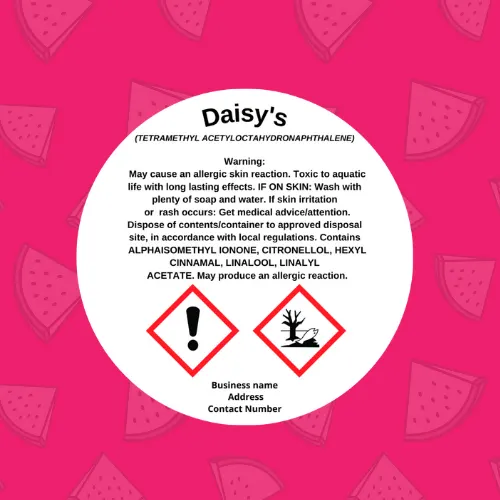
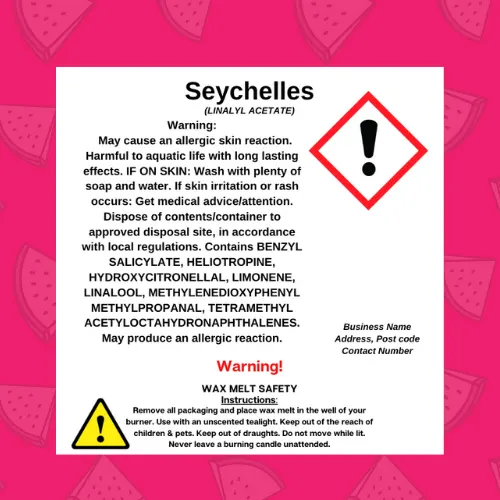
Augeo is a common carrier used in home fragrance, and anyone who blends it into a diffuser, room spray or scented disc needs to know how it affects labelling. Augeo Clean Multi (a glycol-based solvent) is generally treated as non-hazardous on its own. Perfumers alcohol is a different story, because it is flammable and the finished product usually needs a flammable pictogram and a signal word. This page covers circular 25% CLP labels, the sizes that suit small items, and what you actually have to print on them.
What an Augeo CLP label needs to show
CLP is the UK and EU rule set for classifying, labelling and packaging chemical mixtures. A fragrance oil blended into Augeo is still a mixture, so the label depends on the final classification of the whole product, not on the carrier alone.
A compliant label normally carries these elements:
- Product identifier (the name of the scent or product)
- Hazard pictograms, where the mixture is classified
- Signal word, either Warning or Danger
- Hazard and precautionary statements, such as H317 or P102
- Supplier name, full address and telephone number
- Nominal quantity, for example 100 ml
- Any named allergens above the threshold, typically 0.1% (or 0.01% for some)
Your supplier's safety data sheet and a CLP calculation for your exact blend decide which of these apply. Guessing from a similar scent is risky.
Augeo versus perfumers alcohol
This is where most mistakes happen. Augeo-based diffusers are often non-hazardous or only carry sensitiser wording, so the label can be quite plain, sometimes just a skin sensitisation line and a supplier block.
Perfumers alcohol changes that. A room spray at high alcohol content is usually classed as a flammable liquid, which brings the flame pictogram, the word Danger and statements such as H225 or H226 depending on flash point. Add eye irritation and you may need a second pictogram. Two labels for the same bottle type, then, can look very different.
If a product is non-hazardous but contains allergens, you still print the allergen names and the line "Contains [allergen]. May produce an allergic reaction." That is a legal requirement, not decoration.
Why circles suit diffusers and discs
Round labels sit neatly on caps, lids and the flat face of tins and sachets. Common diameters run from about 25 mm up to 50 mm, though warning text becomes hard to read below 30 mm. A 25 mm circle can hold one pictogram, a signal word and a batch number, but not a full block of statements.
For a slim bottle, many makers pair a small circular hazard label with a larger front label that holds the text. For scented hoover discs, a circle on the packet or pot lid works well, though flat packs may suit a rectangle better.
Pictograms have a minimum size too. On packs up to 3 litres the diamond must be at least 10 mm by 10 mm where possible, and at 1 cm it only just stays legible.
Material and print choices
Alcohol and oils attack cheap labels. A glossy waterproof vinyl or laminated paper copes with drips and handling far better than plain matt paper, which smears and stains within a week.
Black and red print on white is the standard, and pictograms need a red border on a white background. Colour printed borders that fade to pink are a common failure on low-quality stock, so test a sample with a drop of your actual blend before ordering a run of 500.
Wax melts and boxed products
The same logic applies elsewhere in home fragrance. If you also make melts, the rules for clp labels for wax melts differ because wax is a solid and the fragrance load is lower, and a guide to clp wax melts shows how the warning wording changes. Gift sets in a reed diffuser box need the label on the inner bottle itself, since the carton may be discarded. Ideas for reed diffuser boxes usually forget this point.
Frequently Asked Questions
Is Augeo classed as hazardous?
Augeo on its own is generally listed as not classified, but the finished mixture is what counts. Fragrance oils often add sensitiser or irritant classifications. Always check the safety data sheet and run the calculation for your final blend.
Do I need a flammable symbol for perfumers alcohol?
Usually yes, when the alcohol content is high enough to give a flash point below 60 °C. Many room sprays fall into that range. A lower alcohol percentage might avoid it, but only the calculation will confirm.
What is the smallest label I can use?
Around 25 mm across is the practical limit for a single pictogram and signal word. For anything with several hazard statements, use a larger label or a fold-out design. Text under about 1.2 mm high becomes difficult to read.
Does the label go on the box or the bottle?
Both, if the bottle can be separated from its packaging. The inner container must carry the full hazard information, because the outer box may be removed and thrown away.